Showing posts with label Mammal. Show all posts

Tuesday, July 19, 2011

Volcano Rabbit


True Wild Life | Volcano Rabbit | The Volcano Rabbit also known as teporingo or zacatuche (Romerolagus diazi) is a small rabbit that resides in the mountains of Mexico. Volcano Rabbits are the second smallest rabbit in the world, only the pygmy rabbit is smaller.


The Volcano Rabbit lives at a high altitude of 3,000 meters above sea level. Grasslands have expanded into the highlands, making it difficult for the rabbit to find food and make their nest holes. Although the Volcano rabbits are not found outside of Mexico there are a handful of isolated populations away from the slopes of the volcanoes but these are very few and far between. The four volcano slopes where these unique rabbits reside are the Tlaloc, El Pelado, Iztaccihuatl and Popocatepetl volcano slopes. 


Volcano Rabbits make their nests deep in the grass. Not only do they eat the grass, but they also use it to hide from their enemies. Volcano Rabbits feed on zacaton grasses, herbs and the bark of alder trees. During the rainy season they will also eat corn and oats.


Volcano Rabbits breed throughout the year with a peak during the warm summer. After a gestation period of 38 - 40 days, they will give birth to 1 - 3 young. At birth the youngsters are covered in fur but their eyes are closed. They are weaned after approximately 20 days and they reach sexual maturity at 4 months old.


Another problem is that the Volcano Rabbits live on an active volcano. If this volcano were to erupt, it would wipe out their small population. So, zoos and preservation centers are working quickly to breed more Volcano Rabbits.

Amami Rabbit

 
True Wild Life | Amami Rabbit | The Amami Rabbit  or Amamino kuro usagi, also known as the Ryukyu Rabbit, is a primitive dark-furred rabbit which is only found in Amami Ìshima and Toku-no-Shima in Japan. The dark-furred Amami Rabbit is known as a living fossil. Its characteristics are identical to rabbits who lived five million years ago. With its small ears and dark eyes the Amami Rabbit (Pentalagus furnessi) contrasts greatly with its more familiar fluffy, white relatives, and yet it's the Amami's distinctive features that make this rabbit so important to the study of the animal world. The Amami Rabbit has remained essentially unchanged since the Miocene Epoch of the Neogene Period, or approximately five million years. It is believed that its ancestors diverged from other leporids, or rabbits and hares, approximately 20 million years ago.

The Amami Rabbit has thick, wooly, dark brown fur that takes on a reddish shade on its underbelly as it ages. It has small ears and small eyes and short legs, but a large, stocky body. It also has a longer face, or snout, than most rabbits. Amami Rabbits do not have tails. They do, however, have long, curved, inch-long nails.


Baby Rabbits are called kits, kittens, or bunnies. Some sources say the Amami Rabbit only has one kit at a time, and other sources say they have two to three, but it is agreed that they generally have two litters each year. The mother builds a den lined with plant materials and tufts of fur then seals the top with the same material so it looks like the rest of the forest floor. Like other rabbits, the mother leaves her offspring to hunt and only returns every other night in an effort to keep predators from locating her den. She can even feed the kit without completely uncovering the den. She unseals the den when the kit is between four and seven weeks old and the baby rabbit joins its mother on the evening hunt for food.


The Amami Rabbit eats grass, fresh branches, and nuts. The Amami Rabbit raises its offspring in rabbit holes. Except at times when the mother feeds milk to her offspring, she will cover the rabbit hole with dirt to conceal it. Isn't that clever!


The reason why the Amami Rabbit retains its primitive form is because this form best suits them for life on the island. But as more people came to the island, the environment started to change. People continued to cut down trees, wiping out sources of food and refuge for the Amami Rabbit. Amami Rabbits are also frequently attacked by mongooses, which were originally brought to the island to exterminate the Habu, a venoemous snake. Today, the Amami Rabbit is on the brink of extinction.

Saturday, July 9, 2011

Brazilian Tapir


True Wild Life | Brazilian Tapir | The South American Tapir (Tapirus terrestris), or Brazilian Tapir (from the Tupi tapi'ira) or Lowland Tapir or (in Portuguese) Anta, is one of four species in the tapir family, along with the Mountain Tapir, the Malayan Tapir, and Baird's Tapir. It is the second largest land mammal in South America, after Baird's Tapir. The Brazilian Tapir (also known as the South American Tapir) is known to be a fantastic swimmer and the Brazilian Tapir is generally found close to water in the Amazon Rainforest.


It is dark brown in color, paler in the face, and has a low, erect crest running from the crown down the back of the neck. The round, dark ears have distinctive white edges. The South American Tapir can be found near water in the Amazon Rainforest and River Basin in South America, east of the Andes. Its range stretches from Venezuela, Colombia, and Guianas in the north to Brazil, Argentina, and Paraguay, in the south, to Bolivia, Peru, and Ecuador in the West.


It is an herbivore. Using its mobile snout, this tapir feeds on leaves, buds, shoots, and small branches that it tears from trees, fruit, grasses, and aquatic plants.


The social life of the South American tapir is unknown. In the San Diego zoo, the captive group forms a structured herd, with dominant and subordinate animals of both sexes. The dominant male and female make what is called the 'sliding squeal', less than a second in duration. On hearing this sound the others make a 'fluctuating squeal', which is longer and quavers rather than merely decreasing in pitch. This is also uttered when a dominant individual approaches, apparently as an appeasement call and as a sign of pain or fear. Tapirs also utter a challenging snort, and a click made with the tongue and palate, perhaps as a species identification.

Mountain Tapir


True Wild Life | Mountain Tapir | The Mountain Tapir or Woolly Tapir  is the smallest of the four species of tapir and is the only one to live outside of tropical rainforests in the wild. It is most easily distinguished from other tapirs by its thick woolly coat and white lips. Their wooly coat is dark brown in colour and they have pale coloured cheeks and throat. Their ears are large and are coloured white on the rims, they have small eyes and a large proboscis.


The Mountain Tapir lives, as the name implies, high in the mountains. But their numbers have diminished because farmers have extended the grasslands for domesticated livestock into the mountains. Mountain Tapirs are found in the forests and grasslands of the Andes at altitudes over 2,000 m (6,560 ft). They are active at night and spend their days resting among thick vegetation.


Tapirs are herbivores, and eat a wide range of plants, including leaves, grasses, and bromeliads. In the wild, particularly common foods include lupins, Gynoxys, ferns, and umbrella plants. It also seeks out natural salt licks to satisfy its need for essential minerals.


The Mountain Tapir is nocturnal, moving during daybreak and nightfall. In the afternoon, they hide in the bushes.


The Mountain Tapir has always been prey to food and game hunting. And now, there are plans to begin mining their mountains for minerals, further destroying the homes of Mountain Tapirs. Because Mountain Tapirs continue to vanish even today, increased measures must be taken to expand the protected area. Otherwise, they will become extinct in the very near future.

Baird's Tapir


True Wild Life | Baird's Tapir | Baird’s Tapir is a species of tapir that is native to Central America and northern South America. Baird’s Tapir is named for the American naturalist Spencer Fullerton Baird who traveled to Mexico in 1843 and observed the animals. However, the species was first documented by another American naturalist, W. T. White. Tapir is the largest land mammal in Central America.


The Baird's Tapir can be identified by the fact that this species of tapir has a cream coloured marking on it's face. The skin of the Baird's Tapir commands a very high price. Leather hunting and deforestation has caused their numbers to drop by less than half. Baird’s Tapir may be active at all hours, but is primarily nocturnal. It forages for leaves and fallen fruit, using well-worn tapir paths which zig-zag through the thick undergrowth of the forest. The animal usually stays close to water and enjoys swimming and wading  on especially hot days, individuals will rest in a watering hole for hours with only their heads above water.


It generally leads a solitary life, though feeding groups are not uncommon and individuals, especially those of different ages (young with their mothers, juveniles with adults) are often observed together. The animals communicate with one another through shrill whistles and squeaks. Baby Tapirs spend a long time in their mother's stomach, and are born only one offspring at a time. Their slow birth rate makes it difficult for their numbers to recover once it declines.


The Baird's Tapir is losing its home as people cut down the trees in the forests where it lives. Deforestation changes the shape of ponds and swamps, rendering water bodies that were once safe unsafe. On top of that, the increase in grasslands near their habitat has infected some Baird's Tapir with a contagious diseases carried by domesticated horses. The number of Baird's Tapir is said to have diminished to less than half over the last 30 years.

Malayan Tapir

 
True Wild Life | Malayan Tapir | The Malayan Tapir, also called the Asian Tapir, is the largest of the four species of tapir and the only one native to Asia. The Malayan Tapir is the largest of the tapir species and has a distinctive white band across it's body. The Malayan Tapir once roamed the tropical forests across South East Asia but the Malayan Tapir today has a much smaller range primarily due to habitat loss.


The Malayan Tapirs are primarily solitary creatures, marking out large tracts of land as their territory, though these areas usually overlap with those of other individuals. Tapirs mark out their territories by spraying urine on plants, and they often follow distinct paths which they have bulldozed through the undergrowth.


The Malayan tapir eat grass and nuts, water plants, and fruits. They put food in their mouths using their noses, just like an elephant. Exclusively a vegetarian, the animal forages for the tender shoots and leaves of more than 115 species of plants (around 30 are particularly preferred), moving slowly through the forest and pausing often to eat and note the scents left behind by other tapirs in the area.


The Malayan Tapirs have black and white sections like the Giant Panda. You'd think it would make them stand out, but tigers and other predators have a hard time finding them. Malayan Tapirs go out at night, so predators can only see the white parts of them. Predators can't see their shape. They look relaxed, but can run away very quickly if in trouble. If they see a predator, they quickly hide under water.


The Malayan Tapirs are skilled swimmers that live in forests where there is water. The forests are disappearing. Living in small numbers in small forests, it's hard to find food. They're also have trouble on finding mates. Their numbers are becoming smaller. Out of all tapirs, Malayan Tapirs are the closest to extinction.

Monday, May 2, 2011

Chacoan Peccary


True Wild Life | Chacoan Peccary | The Chacoan peccary or Tagua  is a species of peccary found in the dry shrub habitat or Chaco of Paraguay, Bolivia and Argentina. About 3000 exist in the world. It is believed to be the closest living relative to the extinct genus Platygonus. The Chacoan peccary has the unusual distinction of having been first described in 1930 based on fossils and was originally thought to be an extinct species. In 1975 the animal was discovered to still be alive and well in the Chaco region of Paraguay. The species was well known to the native people, but it took a while for scientists to rediscover its existence. It is known locally as the tagua.


Chacoan peccaries have received the nickname "pigs from green hell" because of their wild, impenetrable habitats.[citation needed] The Chacoan peccary is confined to hot, dry areas. Dominated by low-lying succulents and thorny bushes, the Gran Chaco is approximately 140,000 square kilometers. There are a few scattered giant trees, but the majority of the vegetation is thorny scrub vegetation. The Chacoan peccary has developed adaptations like well-developed sinuses to combat dry, dusty conditions. The feet are also small, which allows maneuverability among spiny plants.


Chacoan peccaries often travel in herds of up to twenty individuals. They are active during the day, especially in the morning when they are most apt to travel. Herds display a general travel cycle within the homerange of 42 days. This allows the individuals to monitor and show ownership over their areas. These social mammals communicate by various sounds ranging from grunts to chatters of the teeth. Even though individuals may occasionally exhibit aggressive behavior like charging and biting, this species is not as aggressive as others.


As a defensive strategy, members of a herd may line up in a defensive wall; this makes the herds easy targets for hunters. The Chacoan peccary produces a milky, odorous substance that is used for marking trees, shrubs and similar. The substance is secreted from glands located on the back, and is dispersed by rubbing. Frequently bathing in mud or dust, Chacoan peccaries also defecate at particular "stations".

Kowari


True Wild Life | Kowari | also known as the Brush-tailed Marsupial Rat, Kayer Rat, Byrne's Crest-tailed Marsupial Rat, Bushy-tailed Marsupial Rat and Kawiri, is a small carnivorous marsupial native to the dry grasslands and deserts of central Australia. It is monotypical of its genus.  The Kowari is a ground dwelling carnivorous marsupial, living either in its own dug burrow or in the hole of another mammal. The Kowari is a solitary animal and marks its territory with secreations from a scent gland and leaving scats and urine at certain places throught their home teritory When approached, Kowari are very aggressive with much hisssing and chattering and thrashing of its tail.


Sexual maturity in a Kowari is reached in the first year of life but breeding seldom takes place until the second year between May and December. The female Kowari (who may produce 2 litters per season) carries up to six young on her teats for about eight weeks and suckles them in a nest (of soft materials) for a further eight weeks. Young Kowaris may ride on their mothers side or back (2-3 months old). The young become independant 100 days after birth.


The Kowari is well adapted to life in the central desert and does not need to drink, as it derieves needed moisture from its food. When cold and food supply is scarce, the Kowari may become torpid (a form of hibernation). By day, it sleeps in a burrow (sometimes can be seen "Sunbaking"), and at night it is a fierce predator on insects, the larger arthropods, and small vertebrates (eg birds, rodents, lizards) The Kowari can stalk like a cat and uses a direct neck bite when killing large prey.


Its range seems to have contracted considerably in recent decades but it is not clear whether this is an indication of its impending endangerment or of cyclical changes in the density of an opportunistic species, self regulating its numbers to survive in a harsh enviroment. So at this stage its Status is listed as Vulnerable Distribution: 100,000-300,000 square kilometres

Monday, April 25, 2011

Giant Armadillo


True Wild Life | Giant Armadillo | The giant armadillo is the largest of all armadillos and found in South America, east of the Andes, from northwestern Venezuela to northeastern Argentina. Adults grow as long as 35 inches and can weigh over 70 lb. The necks and backs of armadillos are covered with flexible carapaces (shells) consisting of 14 to 17 moveable bands of horn and bone. Their heads are also covered with a similar oval shield. The head, tail and lower edges of the giant armadillo are nearly white, and the rest of the body is dark brown. Underneath the carapace, its naked body appears wrinkly and pinkish in color. It has powerful claws with a very large central claw similar to the claw of the giant anteater. Giant armadillos are very fast on the ground and can sometimes balance themselves on their hind legs and tails, with their forefeet off the ground.


Giant armadillos prefer to live in burrows near water in grassland, brushland, woodland, and forests where termite mounds are present. It is believed that they are very good swimmers. They are active mainly at night and prefer to sleep in the daytime. They are very powerful and quick diggers enabling them to find insects and escape predators by hiding in the ground. Preferred diet is ants and termites, but they will also eat other insects, worms, spiders, larvae, snakes, and carrion. Giant armadillos can consume entire termite mound populations once discovered. Little is known about the mating behavior of this species. Other armadillo species are known to pair up during mating season and share a burrow. Females give birth to one to two young after a gestation period of 120 days. The young armadillos are born with tough leathery skin to protect them from dangerous predators.


Giant armadillos have suffered from loss of habitat due to agricultural development and human settlement, and they are also overhunted by humans for food. Some are killed by farmers because they are thought to damage crops. This species was listed as endangered in 1976, and the continued study of the species and its habitat is necessary to plan additional conservation efforts.

Babirusa


True Wild Life | Babirusa | The Babirusa (Babyrousa babyrussa) is a very special member of the pig family. Up until now the relationship between the Babirusa and the other pig species hasn't been resolved completely. There are pieces of research, which suggest the conclusion, that it is closely related to Hippopotamuses, close relatives of pigs themselves. The babirusa is a very strange looking member of the pig family. They are only distantly related to other pigs, and have been given their own subfamily, the Babirousinae. There are three subspecies of the Babirusa corresponding to the areas where they are found; the Sulawesi, Togian, and Moluccan babirusa. These subspecies have different hair covering, hair color, and tusk and body sizes. Fossil studies seem to show that the babirusa may be more closely related to hippopotamuses than pigs.
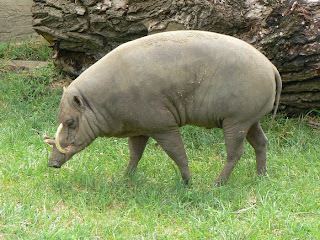

The name babirusa in Malay means "pig-deer". It got this name from its bizarre tusks. The upper canines actually grow up through the skin of it snout from the inside. These 12 inch long tusks then grow up and curl over towards the forehead, sometimes touching the snout again. The lower canines are also very long and protrude from the sides. The two sets of tusks give the appearance of the antlers of a deer. Only the bottom tusks are used offensively. The top tusks can't be used for foraging or as weapons because they are very fragile and lose in their sockets. Females have shorter tusks, or none at all. Babirusa are smaller than domestic pigs. They are 2.8-3.6 feet in length, and 2.1-2.6 feet at shoulder height. The tail is 8-12 inches long and not twisted. Babirusas weigh from 95-220 pounds.


This curly-tusked pig has a rounded body with almost hairless, bristly skin. The sparse hairs are yellowish in color. Their skin is gray to brown, with a lighter colored underbelly. Their legs are thin and longer than on most pigs. Mature babirusas have large folds near their necks and bellies. Babirusa reach sexual maturity from 1 to 2 years. After mating the pregnancey lasts 150 to 157 days. The babirusa only gives birth to 1 to 3 young at a time, unlike other pigs who will have 7 to 9 piglets. The mother babirusa will lie down to nurse her piglets. Although the young will begin to forage within the first week after birth, they aren't weaned until they are 6 to 8 months old. The babirusa has a life span of 24 years.


The babirusa is usually a solitary animal, although it will sometimes live in small groups. Its habits are duirnal, and it tends to feed in the morning. Its diet consists of fruits, nuts, mangos, mushrooms, leaves, and insects found in rotting wood. Unlike other pigs it doesn't root around the dirt for food with its snout. It moves along well-worn trails along the rainforest floor within their territories. It is a fast runner and a good swimmer, and has been seen swimming to off-shore islands. It has a good sense of smell and makes grunting and moaning sounds. When it gets excited it chatters its teeth. Like most other pigs it loves to wallow in mud baths to rid itself of parasites. In the past babirusa were kept by rulers in Sulawesi and given as gifts to visiting diplomats. Masks of Balinese demons often resemble the stangely tusked babirusa.


Unfortunately the future doesn't look good for this amazing creature. They have always been scarce, but are an endangered species today. Although the babirusa avoids farmlands, and isn't persucuted by farmers, it is a favorite target for poachers. Their limited and small pockets of rainforests are also being converted into agriculture. Their wild population is estimated at around 4,000 to 5,000 animals. The IUCN put them on their vulnerable list in 1996, and the U.S. ESA considers them endangered They are on CITES Appendix I.

Thursday, April 21, 2011

Sloth Bear


True Wild Life | Sloth Bear |  The Sloth Bear also known as the Labiated Bear, is a nocturnal insectivorous species of bear found wild within the Indian subcontinent. The sloth bear evolved from ancestral Brown Bears during the Pleistocene and shares features found in insect-eating mammals through convergent evolution. The population isolated in Sri Lanka is considered as a subspecies. Its favourite food is primarily termites and other insects which it snorts and sucks out of termite hills on the ground with a vacuum-cleaner sounding roar that can be heard several hundred yards away.


Using its narrow tongue and long lower lip, which it can extend far beyond its nose, the bear has no difficulty scooping up the tiny morsels. The bear has special adaptations for feeding on termites. It has gap between its front teeth which allows it to suck in the insects, and also the top of its mouth is hollowed and tube-like. The Sloth Bear also eats different insects such as ants and bees, and it also includes fruits, blooms and honey in its menu.


The Sloth Bear has a coarse, shaggy ebony pelt, a white V-shaped mark on its chest and has a protruding lower lip. After mating, there is a period of about 6 to 7 months before the young are born. Generally they breed in June and July and cubs are born from November to January. In South Sri Lanka there appears to be less breeding convergence and cubs may be born at any time of the year. They reach a length from 150 to 190 centimetres. Females reach a weight from 55 to 95 kilograms, while males are clearly heavier and between 80 and 140 kilograms in weight. Although Sloth Bears are rather shy animals, sometimes they are considered as aggressive as other breeds of bear. The total world population of the Sloth Bears is estimated at approximately 7,000 to 10,000 animals, which means that the IUCN lists it as an endangered species .

Monday, April 11, 2011

Zorse


True Wild Life | Zorse | The zorse is a cross between a zebra stallion and a domestic mare. It is also possible to use a zebra mare and a domestic stallion, but owners of valuable zebra mares don't want to waste a year of their breeding life producing a hybrid when they could be producing a zebra foal instead. The crosses were originally done in England and Africa to try to produce a domestic horselike animal that was resistant to diseases spread by the tse tse fly in Africa. Zebras have natural resistance, where domestic donkeys and horses do not. The experimental crosses were actually becoming popular until early in the 20th century when the auto displaced the horse and mule. At that point cross-breeding was largely abandoned. A revival of interest came in the early 1990s, with just about every breed of domestic horse imaginable being tried.


A zorse generally inherits the striping pattern and some of the conformation of the zebra sire with the size, colouration, and temperament of the domestic mare. Coarse bad tempered pony mares produce coarse bad tempered zonies. Mares of quality, especially Quarter horses and American Paint horses, produce some very beautiful zorses that have a good working attitude. If the mare has a pattern, such as pinto spotting or Appy spots, the zorse often will also. You only see the striping pattern on the pigmented areas, never on the white areas. Breeders avoid using gray mares because the zorse can inherit the graying gene and lose all his stripes in a few years! You can still see the stripes on the skin.


Like mules, zorses are born anatomically normal males or females. They exhibit normal breeding behaviour. But like mules they are sterile. Males should be gelded as early as a few months old to prevent dangerous studdy behaviour. A breeder in KY keeps two zorse mares in the pasture with his Paint stallion to keep him company. He has bred them both hundreds of times over the years but no offspring have ever resulted.


Zorses tend to be very hardy and live into their 30s with good care. Their temperaments are generally similar to those of their mothers, but like the zebra they do have a strong flight response. Because of this it's best for a first time hybrid owner to get a zedonk instead. When a zedonk startles he freezes up like a donkey rather than bolt blindly like a horse or zebra.
Related Posts Plugin for WordPress, Blogger...